
How to Wrestle with Your (Story)thinking:
Jun 16, 2026
In 2026, I am thinking, writing, crafting, and consulting with a purpose in mind: that of the educator. To me, the educator spans the wide range of work that I do, both formally and informally, in and outside of postsecondary institutions, workplaces, conferences, professional development sessions, and on/through social media.
I’ve been pursuing a parallel side project, a set of brief audio recordings based on a word that characterizes an essential human quality that interests me and I find valuable in a disrupted world, in part by AI. I just recorded a segment for P, for paradox and paradoxical thinking.
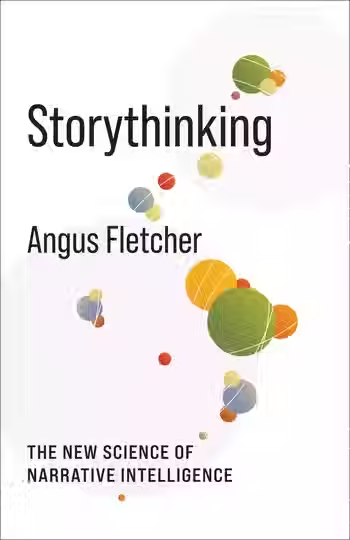
Last week, I wrote about Angus Fletcher’s concept of storythinking and today, I wanted to discuss his suggestions for how to build our own capacities for it.
Related to storythinking, with its attention to stimulation of neural pathways of creation, of imaging various plans and scenarios, the what-ifs and whys, is the paradox.
A paradox confuses, distorts, resists black and white resolutions, that, like a story itself, hooks us to wanting more, inciting our curiosity, and having us speculations on possible (re)solutions.
In Storythinking, Fletcher identifies tactics to develop your own storythinking abilities, which include:
· Prioritizing the exceptional
· Perspective shifting
· Stoking narrative conflict
The parallels between paradoxical thinking, of wrestling with an idea or problem that does not have a simple solution and storythinking, I would argue, are interesting. Fletcher’s argument and research behind storythinking addresses the neuroscience behind the process of creation, and the activation of neural pathways that many of us may be familiar with as a process of learning or practising a skill.
I wonder, even feel, whether the metaphor of wrestling with an idea, such as a paradox, is also initiating neural activity in our brain, building our cognitive fitness as we do “deep work,” the seeming opposite of “cognitive surrender,” where we succumb to shortcuts brought to us by using genAI as a crutch.
(Of course, genAI can be a “force multiplier,” a disruptive and transformative tool to augment our human capacities. However, when contemplating paradoxes and paradoxical thinking, we might see it, stretching the analogy of wrestling, with a cognitive “wrestling partner,” to confound and confuse rather than simplify.)
Fletcher identifies three ways to build our storythinking capacities:
1. Prioritize the exceptional
Fletcher suggests this is counter to our culturally-based temptations to “abstract individuals into universal archetypes”, a la Jungian psychology and the work of our brains’ neural circuitry which seeks to find cognitive shortcuts and discern patterns for the information it consumes.
Fletcher also says that it’s the “opposite way from AI, which treats outlying data points as blips, aberrations, noise to be regressed to a statistical mean.” Rather, by prioritizing the exceptional we are inviting ourselves to wonder, speculate, ponder on whatever is unique or special about a person, a thing, an idea. Intriguingly, it reinforces my thoughts on paradoxical thinking.
2. Perspective shifting
You may have heard of perspective taking as key part of building empathy for another and the old adage of walking in someone else’s shoes. We can see the parallels with stories and viewing the same story through the experience of another character. The idea of perspective shifting is a force detour and derailment, which Fletcher suggests expands our “neural range of action.”
3. Stoking narrative conflict
In some ways this speaks well with notions of paradoxes and dilemmas, of conflicts of ideas and arguments. Fletcher argues that instead of seeking logical syntheses and conclusions, we should instead of attempting “original actions,” testing out what those narratives in our head can do in the world.
Perhaps it’s like pursuing two different potential tactics at once, sparking curiosity and intrigue akin to the what-ifs?



Comments