
From Storytelling to Storythinking

In 2026, I am thinking, writing, crafting, and consulting with a purpose in mind: that of the educator. To me, the educator spans the wide range of work that I do, both formally and informally, in and outside of postsecondary institutions, workplaces, conferences, professional development sessions, and on/through social media.
We're all probably familiar with the power of storytelling to capture our attention, transport us to faraway places, conjure up exciting worlds for us to imagine and situate ourselves. Stories enact something in our brain, incite emotional connection, and allow us to remember and recall certain facts and features that allow us, compel us to share with others. People are telling stories all the time, across cultures, Indigenous, ancestral, historical; and indeed, stories have been vital across and within cultures to encode and communicate important myths, legends, rituals, proverbs that predate writing and literacy and have long continued with it.
For educators and marketers, politicians and entrepreneurs, artists and social media influencers, storytelling remains a vital and valuable to communicate one's message and build connection with others.
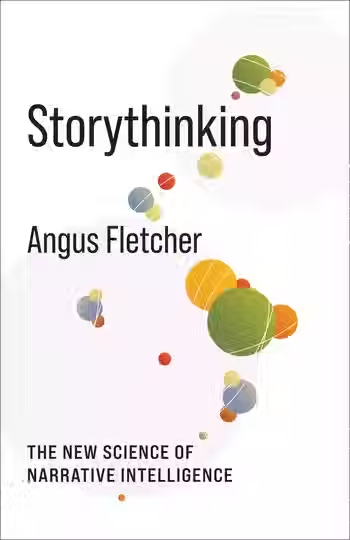
Angus Fletcher, author of Storythinking, doesn't dispute this. However, he argues that thinking through story is an evolutionary adaptation of our brains to hatch new plots of action that may start as dreams and fantasies but lead to "political revolutions, artistic movements, and technological contraptions" (5). In Storythinking, Fletcher ofers a critique of contemporary Western philosophy focus on logic and reason and marginalization of story, touching only sparingly on role and power of story as in the narrative traditions of other, largely ancient cultures.
The freshness of Fletcher's ideas are not so much the recognition of the power and value of story; rather, it's his counter-philosophy and counter-argument of story as "a tool of human intelligence" deploys research and theories of neuroscience and cognition to argue that, in ways to complex for me to unravel fully, that our brain uses stories to think through possible courses of action and "respond to unpredicted challenges and opportunities by linking creative actions into new plans."
Indeed, we might assume that this some kind of rationalizing process of strategic action; however, according to Fletcher, this is not a logical process. Rather, Fletcher argues that our brain's neurons are the sources of our creativity and that this human power of imagination, of "contemplating why and what if", of "modeling hypotheticals, possibles,
counterfactuals, and other kinds of could happen," is storythinking in action and essential to all making and plotting of plans of action.
Fletcher argues that storythinking is linked to Darwin's theory of evolution and the ongoing process of adaptation and natural selection, where the brain's ability to activate and imagine different courses of potential action to increase not only biological success, but the possibility to create "survival-boosting innovations" and increse the "odds of biological success." Of course, this process is not limited to humans, which thus compels us to think of creativity as not only a human property.
Nonetheless, for humans, Fletcher offers a some tactics of how to build and improve our storythinking, which I will discuss in a subsequent blog!


Comments