
Think Like a Human
An Educator’s Purpose in 2026
Jan 6
In 2026, I am thinking, writing, crafting, and consulting with a purpose in mind: that of the educator. To me, the educator spans the wide range of work that I do, both formally and informally, in and outside of postsecondary institutions, workplaces, conferences, professional development sessions, and on/through social media.
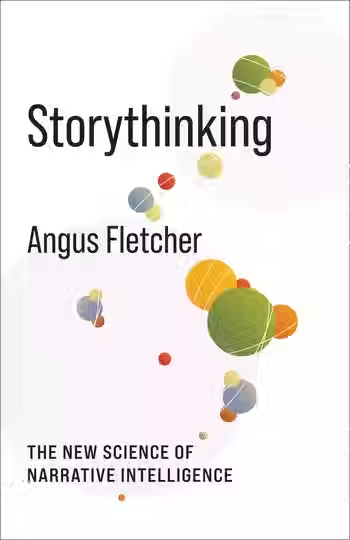
Over the holidays, I read David Weitzner’s Think Like a Human: The Power of Your Mind in Age of AI (2025). Weitzner pairs his penchant for philosophy with research and teaching in business strategy to criticize our unfolding world in which AI is increasingly dominant and dominated by a handful of tech companies, with increasing compliance and support from mainstream media and governments.
Weitzner frames these companies as “algorithmic supremacists” and “surveillance capitalists,” analyzing and critiquing their worldview in which AI and automated processes continue to transform the ways in which we live, shop, work, educate, travel, entertain ourselves, connect with others, find partners, and beyond.
Rather than seeing these transformations as liberatory or “freeing” human labour and inventiveness for other kinds of endeavours, Weitzner evokes, for great narrative effect, a binary, “Us vs. Them" dystopia of greed and cynicism, of the impoverishing and overpowering of humanity, where the “algorithmic supremacists” and “surveillance capitalists” (seek to) control human thoughts and actions and wildly profit from it.
Against this dystopia, Weitzner offers a counter-narrative: a human-centric, embodied ways of being that is described as “artful intelligence.” Artful intelligence, which Weitzner describes as an “action-oriented process of cognition (72) occurs through what Weitzner describes as thinking with BEAM (body, environment, action, mind) and defending your VICE (volition, intent, choice, and explanations) (73).
Elaborated in the first third of the book, Weitzner spends the rest of his chapters to sketch out artful intelligence and actions in play, which seek to empower and centre human curiosity, creativity, inventiveness, relationship-building, and community-making. Weitzner’s thesis uses examples from the performing arts and cycling, meanders through discussions of love and awkwardly paints “social justice warriors” with the same brush as the “surveillance capitalists.”
In addition, the universalized “human” is limited to being undifferentiated and Western.
Yet, Think Like a Human, is a call to action and a catalyst of resistance of the hustle and greed of AI tech evangelism. It invites “us” to develop and use our own artful intelligence to create and build spaces where our BEAM and VOICE can thrive and flourish, to assert our individual and collective agency against technocratic, oligarchic dominance.
Indeed, it offers an insightful statement of the purpose of the educator and other human endeavours.



Comments